

Protect Your Eyes: UV + Infrared Damage Outdoors
At Nines Optics, we’re passionate about protecting your eyes from the full spectrum of harmful sunlight—not just the visible glare, but the invisible threats like UV and near-infrared (NIR) radiation that build up damage over time. Your eyes are exposed to these rays every time you head outdoors, and the risks add up: cataracts, macular degeneration, pterygium, eye strain, and more. Here's the science-backed breakdown, plus why our patented NIRTECH® lenses go beyond what standard polarized sunglasses can do.
How UV Rays Damage Your Eyes
Ultraviolet radiation hits your eyes in two main forms:
- UVB (280–315 nm) primarily affects the surface, causing photokeratitis (aka "snow blindness" or "welder's flash")—a painful, temporary inflammation of the cornea. Over the years, repeated exposure leads to permanent issues like pinguecula (yellowish bumps on the white of the eye) and pterygium ("Surfer's Eye"), where tissue grows across the cornea and can distort vision.
- UVA (315–400 nm) penetrates deeper, reaching the lens and—even in adults—a small percentage to the retina. This triggers oxidative stress, protein clumping, and clouding in the lens, accelerating cataracts. The World Health Organization links up to 20% of cataract-related blindness worldwide to sun exposure, with UVB as a major preventable risk factor for cortical cataracts. In children, clearer lenses let more UVA through (up to 10x more than in adults), raising risks for retinal damage and age-related macular degeneration (AMD) later in life.
The National Eye Institute and studies from experts like Dr. Ram Nagaraj at Case Western Reserve University confirm: cumulative UV exposure depletes natural antioxidants in the lens and promotes free radical damage that clouds vision over decades.
How Infrared (NIR) Rays Damage Your Eyes
Unlike UV's chemical damage, infrared radiation—especially near-infrared (NIR/IR-A, 700–1,400 nm)—harms through heat. These invisible rays increase molecular vibration, raising tissue temperature without triggering your blink reflex or any immediate "hot" sensation.
- Near-IR penetrates deep, heating the lens and retina. Research from Uppsala University Hospital (Professor P.G. Söderberg) shows limbal tissue temperatures can spike by ~10°C under intense exposure, denaturing proteins and accelerating cataract formation—similar to historical "glassblower's cataracts" in heat-exposed workers.
- The retina has no pain receptors, so thermal damage happens silently. By the time you notice vision changes, it may be irreversible.
- Mid- and far-IR mostly affect the surface (cornea clouding, pupil changes), but near-IR is the bigger long-term concern for everyday outdoor use.
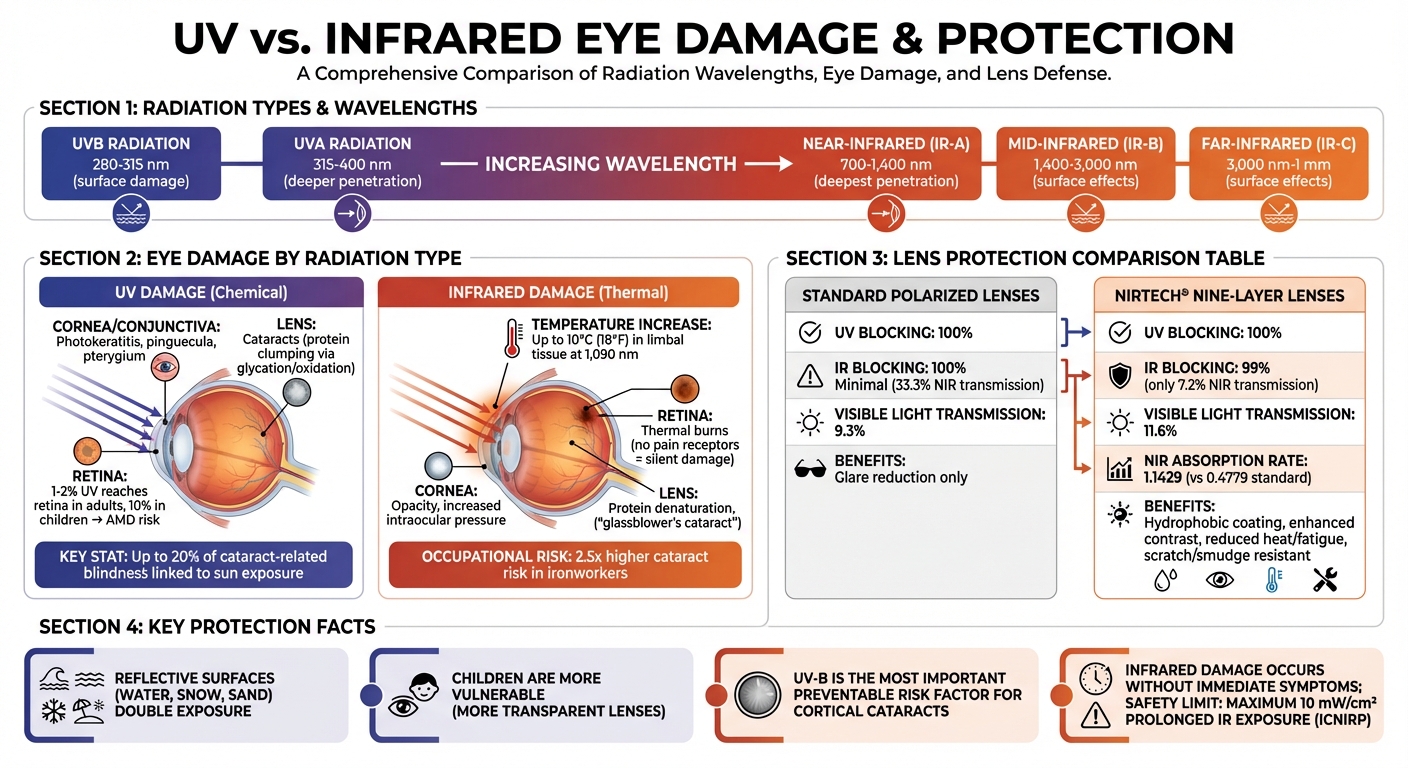
Standard polarized sunglasses block 100% UV but let through significant NIR (often ~33% transmission), allowing heat buildup that contributes to fatigue, strain, and cumulative damage—especially near water, snow, sand, or during prolonged activities.
Key Risks and Why Protection Matters More Than Ever
Reflective surfaces amplify exposure by up to double. Kids are extra vulnerable to developing eyes and more outdoor time. Long-term, UV and NIR together increase risks of cataracts, AMD, pterygium, and chronic eye discomfort. Oxidative stress from UV and thermal protein denaturation from NIR compound over years—yet most eyewear stops at UV400.
How NINES® with NIRTECH® Lenses Protect You Better
We developed NIRTECH®—our patented nine-layer lens technology—to deliver true full-spectrum protection. NIRTECH® blocks:
- 100% of UVA & UVB
- Harmful near-infrared radiation (reducing transmission to just ~7.2%, vs. ~33% in standard polarized lenses)
- Harmful blue light
This selective filtering acts like an equalizer: it cuts "visual noise" from harsh glare and invisible NIR heat while preserving natural color contrast, depth perception, and clarity. You get reduced eye strain and fatigue, cooler comfort during long days outdoors, and better defense against cumulative damage.
Our NINES® sunglasses pair NIRTECH® with premium features:
- Hydrophobic coating to repel water, oil, and smudges
- Scratch-resistant layers for durability
- Optimized visible light transmission (~11.6%) for bright, vivid vision without excessive darkening
Quick Comparison: Standard Polarized vs. NINES® NIRTECH®
- Standard Polarized — 100% UV block, excellent glare reduction, but minimal IR protection (~33% NIR transmission) → leaves eyes vulnerable to heat and long-term thermal damage.
- NINES® NIRTECH® — 100% UV block + ~93% NIR block (7.2% transmission), plus enhanced contrast, reduced heat/fatigue, hydrophobic & scratch-resistant coatings → superior all-day comfort and protection.
The difference shines during fishing, boating, hiking, or any reflective environment—where NIR heat adds up fast.
Takeaway from the Nines Optics Team
Don't settle for UV-only protection. UV and near-infrared rays are silent threats that accumulate over a lifetime, contributing to preventable eye conditions. Our NIRTECH® lenses were engineered for real-world outdoor use: crystal-clear vision, less strain, and comprehensive shielding against both photochemical (UV) and thermal (NIR) damage.
Step outside confidently with NINES®. Your eyes deserve more than basic sunglasses—they deserve the full-spectrum innovation only NIRTECH® delivers.
Ready to upgrade? Explore our NIRTECH® collection at ninesoptics.com and feel the difference on your next adventure.
Quick FAQs
Can infrared rays damage eyes without feeling hot? Yes—NIR often causes silent thermal damage. That's why NIRTECH® is essential for blocking it before it builds up.
Do kids need extra eye protection? Absolutely. Children's lenses let through far more UV and NIR. Always choose 100% UV + NIR-blocking lenses like ours—no toy or cheap options.
How do I know if sunglasses block NIR? Look for advanced tech like our patented NIRTECH®. We proudly specify the superior NIR blocking in every pair of NINES® sunglasses.